

Lynn Valley


ISA Certified Arborist
ISA #: PN10411A
ISA Tree Risk Assessment Qualified
BC Forest Safety Certified Fallers
$2 Million Liability Insurance
Worksafe BC
The history
Before it was Lynn Valley, it was Shaketown, a logging settlement built around cedar shingle mills. Shingle bolts came off the slopes on skid roads and flumes, and the McNair brothers opened the valley's first mill in 1903. The forest they cut was enormous. In 1902, a Douglas fir felled near today's Argyle Road was measured on the ground at a reported 415 feet, one of the tallest trees ever recorded.
The firs and cedars in Lynn Valley yards today are the forest that grew back, many now close to a century old and rooted among the original stumps. That matters. Laminated root rot, the most damaging disease of coastal Douglas fir, spreads root to root and can survive in old stumps for up to 100 years. The crown usually looks healthy until the root damage is well advanced.

Local Considerations
What to expect from a tree service in Lynn Valley
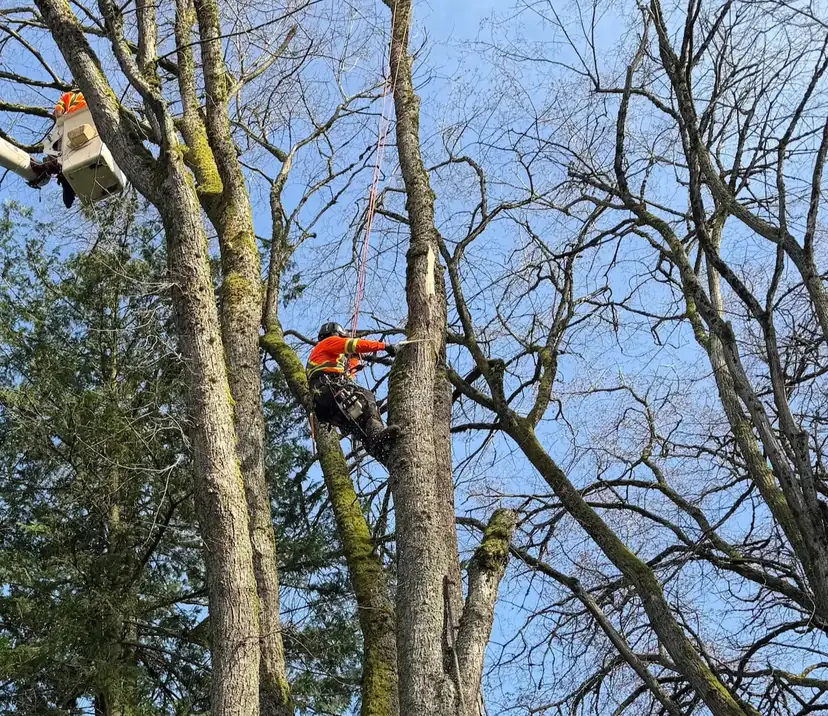
Much of Lynn Valley is laid out as ordinary suburban streets, but the largest trees are rarely at the front. They sit at the back of the lot, along a ravine edge or the boundary with Lynn Canyon Park, Lynn Headwaters or one of the neighbourhood's creek corridors. With no machine access past the house, most of this work is climbing and rigging: sections lowered on ropes and brought out to the street for chipping.
The back fence also raises a question of ownership. A tree on or straddling District land, including parks and boulevards, is protected regardless of size, and so is any tree within 15 metres of the top of a creek bank. Before anything near a property line or ravine is cut, it's worth confirming whose tree it is and which rules apply. For a large fir showing any sign of decline, the right first step is an assessment by an ISA TRAQ (Tree Risk Assessment Qualified) arborist, not a removal quote.